https://www.podbean.com/media/share/pb-4kvvs-158b045
Walking around the park behind the hospital and thinking about constancy in nature—the daily rising of the sun, the seasonal cycles of trees, the weather and our own routines and habits all contribute to the constancy of nature.
https://www.podbean.com/media/share/pb-ru5bj-1589706
The flow researcher whose name I couldn’t remember is Mihaly Csikszentmihalyi (pron: Mi-hi Chick-sent-mi-hi) in this episode of Walk the Pod: 10 minute walking. Music still too loud, I will adjust tomorrow. Thank you for bearing with, dear friends.
Consuming the news, all that is cruel and unfair is laid out for us to read, watch or listen to in all its mawkish detail. Putin remains free to wreak havoc, natural disasters destroy the homes of innocent families, Trump gets another shot at re-election, despite everything. And yet, every time hope gets crushed to the ground, it rises again.
Emily Dickinson’s poem, “Hope” is the thing with feathers calls hope, ‘the thing with feathers, that perches in the soul / And sings the tune without the words / And never stops at all. Hope never stops.
Positive change happens at glacial pace, with as many setbacks as steps forward. Trump and his cronies were referred to as, ‘the last fart of a dying dog’ back in 2016. Whilst not as majestic a phrase as Martin Luther King Junior’s ‘The moral arc of the universe is long, but it bends towards justice’—inspired by Theodore Parker’s sermon on Justice and the Conscience—the ‘dying dog’ brigade and Dr King were on the same page.
They were both trying to say that things get better, s l o w l y. And when things are getting better, sometimes we have to endure a moral Luddite like Trump throwing himself under the wheels of progress, in order to stall things for a few more years.
Diagnosing a problem
We move, at a glacial pace, continually into slightly better circumstances. The Internet, media, and social media help shine a light on what’s happening, so that we can begin to define the curves and edges of our most critical problems. If we can define, we can diagnose.
And as Rebecca Solnit puts it in Hope in the Dark, we do not need to know the prescription before the diagnosis is complete.
In 2016 I quit working in a newsroom and stopped consuming the news for the sake of my mental health. Trump’s election, Brexit, then Covid eventually led to my turning off Radio 4 in the house, so that I could have some peace from the news hurricane.
But having re-read Solnit’s wonderful Hope in the Dark this month, I realise that whilst it’s painful to engage with the details, reading bad news helps us to see the issue properly (media and social media bias notwithstanding), in order to understand what the shape of the problem is—where we are in the fight.
I recently watched She Said, a film of the 2019 book by Megan Twohey and Jodi Kantor about their struggle to expose the systemic abuse of women in Hollywood by Harvey Weinstein, amongst others. Despite pressure to silence the brave women who exposed Weinstein’s horrendous behaviour, these two journalists knew the truth. They were determined to expose it, and have changed the global workplace for women in the process. The subsequent MeToo movement became too overwhelming to document. It has changed the workplace, and the world.
Hope makes the present inhabitable
Hope is, in a sense, a search for the truth. Once uncovered, the truth is there to be held up to the light, if we are brave enough. It is not the likely success of the initiative that should fuel our fight. It is adhering to the truth, and helping to spread it as far as we can.
Solnit argues that we would not have had the same war in Iraq if global publics had acquiesced to the original Bush/Blair plan. The global protest movement surrounding the war changed it. Reduced the scope of it. Made it smaller, and shorter.
The millions of people who marched, the individuals who made ‘STOP THE WAR’ placards didn’t get what they wanted, but they changed the course of things, and who knows how much more extensive the war would have been without them.
To be effective, activists have to make strong, simple, urgent demands…And they have to recognise that their victories may come as subtle, complex, slow changes…and count them anyway. A gift for embracing paradox is not the least of the equipment an activist should have.
rebecca solnit
Solnit points out that hope is not a passive emotion but rather a stirring force that will get people up off their sofas and into the world to make a difference:
Hope is not like a lottery ticket you can sit on the sofa and clutch, feeling lucky… Hope is an ax you break down doors with in an emergency; because hope should shove you out the door
Rebecca Solnit
‘To hope’, Solnit writes, ‘is to give yourself to the future, and that commitment to the future makes the present inhabitable.’
Look for the helpers
The philosopher Ryan Holiday writes in his modern stoicism book, Stillness is the Key, about Fred Rogers, a American childrens’ television presenter whose show, Mr Rogers’ Neighborhood, aired from 1968 to 2001.
“Look for the helpers”, Mr Rogers would tell the children whenever a horrible news story broke in the world. “The world is full of doctors and nurses, police and firemen, volunteers, neighbours and friends who are ready to jump in to help when things go wrong.”
Hope as a way to find purpose
Hope, looking for helpers, and helping itself, gets us through when something utterly unfair is happening. Hope doesn’t mean that everything will turn out ok, but it can help us to find purpose and meaning in a world that seems fundamentally unfair and difficult.
The playwright, intellectual and politician Vaclav Havel used hope as his own lifeline whilst imprisoned between 1979 and 1983. He makes clear that hope is part of the soul, to be found even in seemingly hopeless situations:
Hope, in this deep and powerful sense, is not the same as joy that things are going well, or willingness to invest in enterprises that are obviously headed for early success, but, rather, an ability to work for something because it is good, not just because it stands a chance to succeed.
vaclav havel
Havel went on to be elected President of Czechoslovakia in 1989 after hope got him through his time in prison.
The arc of the moral universe may bend slowly towards justice, but it is up to each of us to help bend it. We must search for, uphold, and spread the truth, however gradual and imperfect the progress.
Though the present remains full of suffering and setbacks, we can make it inhabitable through acts of hope – by looking for helpers, helping others, and finding purpose and meaning. Hope fuels the spirit when circumstances seem bleak; it pushes us to keep fighting for what is right and for the truth.
We may not see the fruits of our labour in our lifetimes, but we can live with purpose knowing we stood for truth and justice. The future is uncertain, yet hope makes today inhabitable and gives us the strength to take the next step.
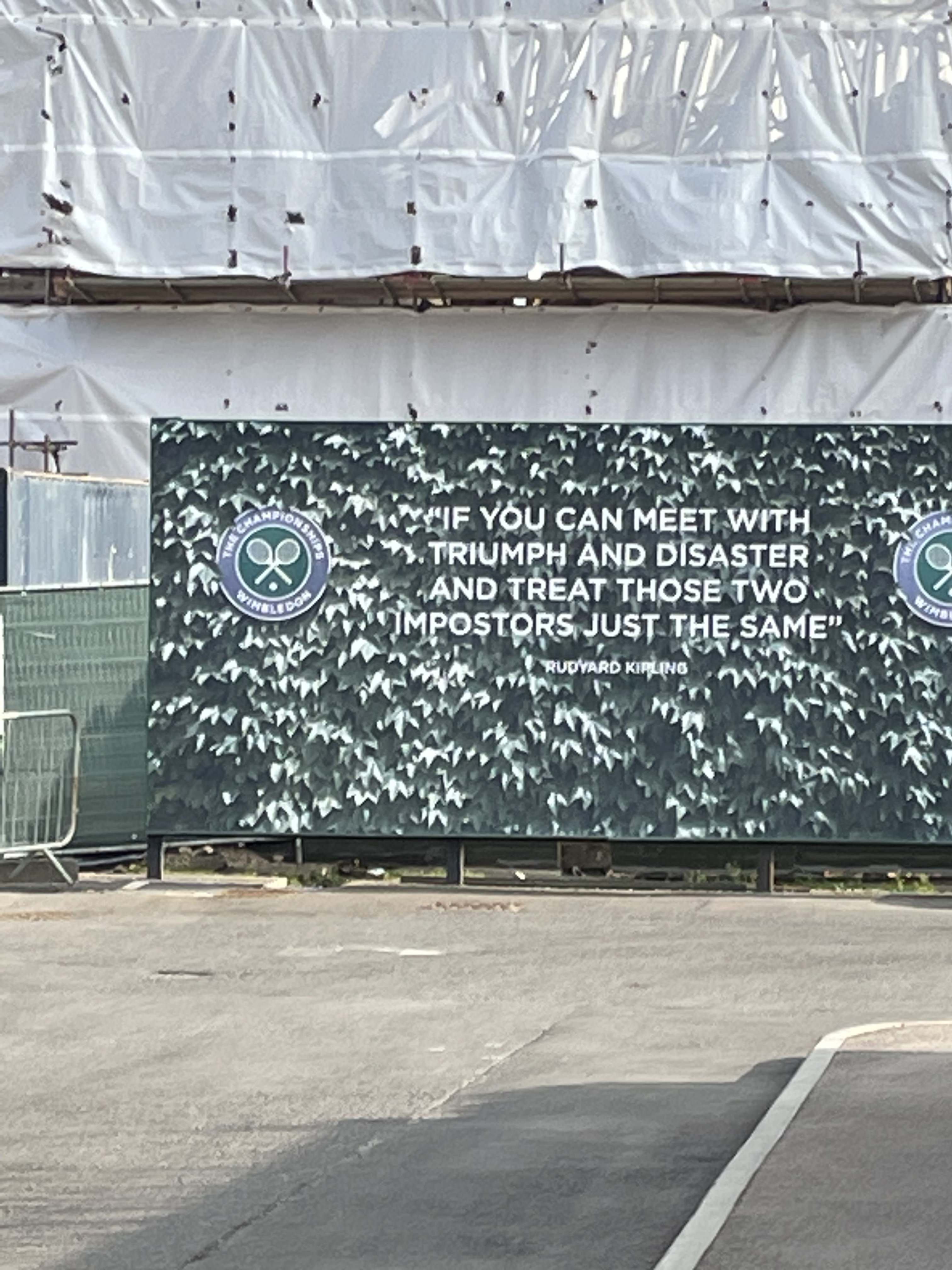
I walked down a road called Grand Drive in Morden today and stopped outside a tennis academy, which had a quote from Rudyard Kipling’s If printed on a large, Wimbledon branded, hoarding:
“If you can meet with triumph and disaster and treat those two imposters just the same.”
Rudyard Kipling
I’ve read If before and like the bit about not losing your head when all around you are losing theirs (and blaming it on you.) Dad quotes that to me occasionally. Working in a Higher Education setting, it’s good advice. But the bit about triumph and disaster hadn’t caught my attention.
It’s interesting that the All England Club Community Sports Ground chose to put this quote in a prominent place (visible from the entrance of the ground). I caught the attention of a security guard in a hut by walking up to the gate so I could take a picture of it.)
“It’s ok!” I reassured the guard, “I’m not coming in, I just want to take a picture of that quote.” He smiled at me in a slightly pitying way and went back to his paper.
But the quote made me think. Often, I hear giddy sports journalists bouncing up to cricketers and trying to get them to display a bit of emotion after a particularly spectacular win, or defeat (mostly win these days, amazingly.) “How did that feel?” they implore, hoping the triumphant captain will drop the veil of grace and humility and admit that they enjoyed smashing all hell out of New Zealand just a little bit.
They absolutely refuse to comply. Presumably, media training these days recommends that an astonishing victory or defeat should not lead to a change in behaviour. Why? Because of the knock on effect on team mates and our own confidence. Melancholy, or complacency, sets in, and performance is negatively affected. Much better then to treat the latest result as a fleeting occurrence, and to get back to the nets.
Tennis stars are much the same. Andy Murray used to come in for a drubbing by the satirical Radio 4 show, Dead Ringers, which used to poke fun at his monotonous responses to any and all questions from journalists. But whatever you think about Andy Murray as a person or a player, the approach is spot on. Whether we win or lose, we should disengage from the result, and get back to practice.
The I Ching agrees. When we look at hexagrams such as 63: After Completion, it counsels to avoid any kind of unbalancing thoughts that might disturb our dignity or independence (Anthony, 1988). The I Ching may be a bit ‘woo’ for many Walk the Pod readers, but my position on things like tarot or tao is that if the guidance is sound, and written by a wise person whose values I agree with, then it doesn’t matter whether cards, tea leaves or the shape of an ink blot was the origin.
I don’t believe that anything supernatural is going on, but I like to believe that in a world where we can occasionally see all of science overturned by a new theory, it’s possible that human intuition taps into something more profound and scientific that we don’t yet understand.
The ancient Persian saying, ‘this too shall pass’ is popular for just the same reason. The good, as well as the bad, shall pass, and this phrase reminds us to take it one day (one hour, or one minute) at a time when things are bad, and to enjoy every moment when things are good. Because nothing lasts for long.
References
Anthony, C.K., (1988) A Guide to the I Ching. 3rd edn. Massachusetts: Anthony Publishing Co.
“Do not dream of possession of what you do not have: rather reflect on the greatest blessings in what you do have, and on their account remind yourself how much they would have been missed if they were not there.
“But at the same time you must be careful not to let your pleasure in them habituate you to dependency, to avoid distress if they are sometimes absent.”
– Marcus Aurelius, Meditations, Book 7, Chapter 27
In this passage, Marcus Aurelius, the renowned Stoic philosopher, Roman emperor, and star of What Would Marcus Do, a much loved segment of Walk the Pod episodes of the past, highlights the importance of acknowledging and appreciating the abundance present in our lives.
It’s all too easy to become fixated on what we lack, and to believe that our happiness and fulfilment depends on obtaining these things. The reality is that once we get to our chosen rainbow uplands, we spot another rainbow upland! Just over the horizon with an extra unicorn!
And immediately, we adjust our happiness downwards to accommodate the JOY we will feel when we reach this new and shiny destination.
But Marcus reminds us that by taking stock of the blessings we already have and cultivating gratitude for them, we can come to appreciate the richness of our lives and find contentment in the present moment.
Perhaps we should scan the horizon only for genuine threat rather than opportunities, and instead pay attention to what’s directly in front of us.
This idea of inner independence is a central tenet in Taoist philosophy, as exemplified in the ancient Chinese text, the I Ching.
I Ching says that true fulfillment comes from within, and encourages detachment from the frustrations of life, alongside the cultivation of inner independence in order to find peace and contentment regardless of external circumstances.
As I explained in today’s episode, I don’t mind if my daily reminders of how to be a happy human in the world are based on a system that taps into the supernatural, IF the advice behind the tarot card, hexagram or tea leaves is sound.
I see these systems, rituals or games more like a trusted friend whose advice I can take or leave. An alternative way of looking at it is as a way to randomise snippets of good advice on subjects that I need reminding of regularly. Such as, for example, not to try to get too much out of a situation, to detach and remember not to strive too much for success.
Simply choose a sound direction, then keep turning up, doing the good work, fighting the good fight and be prepared to seize the moment when those fleeting opportunities come along. And crucially, be prepared to change course when needed, no matter the upheaval required to do so.
Both Stoicism and Taoism advocate for embracing abundance as a means of cultivating inner independence. This is not to say that we should ignore or downplay our struggles, but rather that we should recognise and be grateful for the myriad blessings in our lives, rather than fixating on what we lack.
By following this approach, we can learn to find fulfillment and contentment in the present moment, regardless of external circumstances.
So, how do we go about counting our blessings and cultivating gratitude? Here are a few ideas:
– Take part in GratiTuesday: Take some time once a week to write down a few things you’re grateful for, or voicenote a friend with your GratiTuesday thoughts. These can be as simple as noticing a beautiful sunset, a warm meal, or a good, tipsy laugh with a friend at the end of a long week. Reflecting on these things can help shift the focus to everything that’s provided a little light.
“No matter how vast the darkness, we must supply our own light.”
– Stanley Kubrick
– Practice mindfulness: Pay attention to the present moment and all the good things that are happening. Take a few minutes each day to simply be present and notice the beauty and blessings in your life. Ignore, just for a moment, the cereal strewn around the place or the clothes that have been piling up all week. When the news is bad, look for the helpers, and try to help them.
– Show gratitude: Expressing gratitude to others can not only make them feel good, but it can also help us appreciate the good things in life. Take the time to write a thank-you note, say thank you in person or rugby tackle them to the ground to cover their upturned face with a thousand kisses, if you have consent to do that kind of thing.
– Give back: Helping others can also help us appreciate what we have. Consider volunteering or donating to charity. This series, I’m encouraging everyone to download trundl, the walking app that converts your kms into donations for charities including Dogs for Autism and the Trussell Trust. We hope it will be available outside of the UK before too long.
We have one week to go until the end of Series 33, dear Poddies, and I look forward to completing our topic of abundance.
Of course, I will need regular reminders to flip myself out of scarcity mode, so I dare say we’ll come back to this regularly.
You are warmly invited to join me next Friday evening at 6pm for our end of series wrap party, from 6-7 GMT. Find me in the Discord voice channel, for which you’ll need to join the Walk the Pod lunch time walk club, via patreon.com/rachelwheeley


 Rachel Wheeley MCIPR FRSA