Hope: a stirring force for good

Consuming the news, all that is cruel and unfair is laid out for us to read, watch or listen to in all its mawkish detail. Putin remains free to wreak havoc, natural disasters destroy the homes of innocent families, Trump gets another shot at re-election, despite everything. And yet, every time hope gets crushed to the ground, it rises again.

Emily Dickinson’s poem, “Hope” is the thing with feathers calls hope, ‘the thing with feathers, that perches in the soul / And sings the tune without the words / And never stops at all. Hope never stops.
Positive change happens at glacial pace, with as many setbacks as steps forward. Trump and his cronies were referred to as, ‘the last fart of a dying dog’ back in 2016. Whilst not as majestic a phrase as Martin Luther King Junior’s ‘The moral arc of the universe is long, but it bends towards justice’—inspired by Theodore Parker’s sermon on Justice and the Conscience—the ‘dying dog’ brigade and Dr King were on the same page. 

They were both trying to say that things get better, s l o w l y. And when things are getting better, sometimes we have to endure a moral Luddite like Trump throwing himself under the wheels of progress, in order to stall things for a few more years.

Diagnosing a problem

We move, at a glacial pace, continually into slightly better circumstances. The Internet, media, and social media help shine a light on what’s happening, so that we can begin to define the curves and edges of our most critical problems. If we can define, we can diagnose. 

And as Rebecca Solnit puts it in Hope in the Dark, we do not need to know the prescription before the diagnosis is complete.

In 2016 I quit working in a newsroom and stopped consuming the news for the sake of my mental health. Trump’s election, Brexit, then Covid eventually led to my turning off Radio 4 in the house, so that I could have some peace from the news hurricane.

But having re-read Solnit’s wonderful Hope in the Dark this month, I realise that whilst it’s painful to engage with the details, reading bad news helps us to see the issue properly (media and social media bias notwithstanding), in order to understand what the shape of the problem is—where we are in the fight.

I recently watched She Said, a film of the 2019 book by Megan Twohey and Jodi Kantor about their struggle to expose the systemic abuse of women in Hollywood by Harvey Weinstein, amongst others. Despite pressure to silence the brave women who exposed Weinstein’s horrendous behaviour, these two journalists knew the truth. They were determined to expose it, and have changed the global workplace for women in the process. The subsequent MeToo movement became too overwhelming to document. It has changed the workplace, and the world.

Hope makes the present inhabitable

Hope is, in a sense, a search for the truth. Once uncovered, the truth is there to be held up to the light, if we are brave enough. It is not the likely success of the initiative that should fuel our fight. It is adhering to the truth, and helping to spread it as far as we can.

Solnit argues that we would not have had the same war in Iraq if global publics had acquiesced to the original Bush/Blair plan. The global protest movement surrounding the war changed it. Reduced the scope of it. Made it smaller, and shorter. 

The millions of people who marched, the individuals who made ‘STOP THE WAR’ placards didn’t get what they wanted, but they changed the course of things, and who knows how much more extensive the war would have been without them.

To be effective, activists have to make strong, simple, urgent demands…And they have to recognise that their victories may come as subtle, complex, slow changes…and count them anyway. A gift for embracing paradox is not the least of the equipment an activist should have.

rebecca solnit

Solnit points out that hope is not a passive emotion but rather a stirring force that will get people up off their sofas and into the world to make a difference:

Hope is not like a lottery ticket you can sit on the sofa and clutch, feeling lucky… Hope is an ax you break down doors with in an emergency; because hope should shove you out the door

Rebecca Solnit

‘To hope’, Solnit writes, ‘is to give yourself to the future, and that commitment to the future makes the present inhabitable.’

Look for the helpers

The philosopher Ryan Holiday writes in his modern stoicism book, Stillness is the Key, about Fred Rogers, a American childrens’ television presenter whose show, Mr Rogers’ Neighborhood, aired from 1968 to 2001. 

“Look for the helpers”, Mr Rogers would tell the children whenever a horrible news story broke in the world. “The world is full of doctors and nurses, police and firemen, volunteers, neighbours and friends who are ready to jump in to help when things go wrong.”

Hope as a way to find purpose

Hope, looking for helpers, and helping itself, gets us through when something utterly unfair is happening. Hope doesn’t mean that everything will turn out ok, but it can help us to find purpose and meaning in a world that seems fundamentally unfair and difficult.

The playwright, intellectual and politician Vaclav Havel used hope as his own lifeline whilst imprisoned between 1979 and 1983. He makes clear that hope is part of the soul, to be found even in seemingly hopeless situations:

Hope, in this deep and powerful sense, is not the same as joy that things are going well, or willingness to invest in enterprises that are obviously headed for early success, but, rather, an ability to work for something because it is good, not just because it stands a chance to succeed.

vaclav havel

Havel went on to be elected President of Czechoslovakia in 1989 after hope got him through his time in prison.

The arc of the moral universe may bend slowly towards justice, but it is up to each of us to help bend it. We must search for, uphold, and spread the truth, however gradual and imperfect the progress.

Though the present remains full of suffering and setbacks, we can make it inhabitable through acts of hope – by looking for helpers, helping others, and finding purpose and meaning. Hope fuels the spirit when circumstances seem bleak; it pushes us to keep fighting for what is right and for the truth.

We may not see the fruits of our labour in our lifetimes, but we can live with purpose knowing we stood for truth and justice. The future is uncertain, yet hope makes today inhabitable and gives us the strength to take the next step.
Mastodon and a secret podcast

I recently joined the open source community / social media alternative, Mastodon.

It has been interesting trying to use this new platform as an ex-Twitter user. I find the decentralised nature of it so confusing, but also understand that this is what is going to prevent it from being bought by the likes of E*** M***.

I’ve worked out so far that I have to log in via the server I registered on originally, but I can follow people, no matter what server they are registered on. Members of the Walk the Pod lunch time walk club have helped me get to grips with it. If you’d like to follow me, you can do so @rachelwheeley@mastodonapp.uk.

In other new-technology-is-confusing news, I am trying to reinstate the secret podcast from behind the scenes of Walk the Pod which was originally set up on Patreon but couldn’t be integrated with Spotify.

Spotify and Patreon now have a proper working relationship, which means that potentially, you will be able to access this very easily, by clicking this link.

Please note that this podcast is only available to members of the Walk the Pod lunchtime walk club, which is currently closed to new subscribers, but will open again in September. For the main Walk the Pod podcast, click here.

Integrity

Hello Poddies!

I’ve been discussing integrity this week on Walk the Pod. It’s been a tricky subject to pin down. We’ve discussed whether it is to do with being complete, or whole, and whether it has to do with doing the right thing, even when no one is watching.

I’d like to take a moment to consider artistic integrity now, in anticipation of further discussion next week. I read John Steinbeck’s Working Days: The Journal of ‘The Grapes of Wrath’ a while ago. It is a diary of writing a novel, The Grapes of Wrath, which I could never get into.

But the diary is wonderful. In it, Steinbeck discusses that before he was famous, he couldn’t get a word published, and now that he’s famous, folk want to read absolutely everything he can think of.

Consequently, there is not so much scrutiny of the quality of his work. He is acutely aware that this means he can write poor quality prose, and get away with it.

He thanks the trees around his home in Monte Sereno, California, for keeping him honest.

We come now to the dangerous part. Whereas a few years ago I could not sell my work—now it is so in demand that anything with my name on it would be snapped up. And that is the worst thing of all. That is the goodness of this ranch. Here I can lose the fanfare. Here I become the little creature I really am. One cannot impress our forest.

John steinbeck, working days: the journals of the grapes of wrath

Video blog posts on Patreon

If you’re a follower of my blog here on WordPress, I have some exciting news. I’ve been dabbling with video blog posts over on Patreon, and have now published 7 videos on the platform.

It’s a little like podcasting, only, with pictures! Will it catch on? It’s been a bit of a learning curve for me as I work out which way up to hold my iPhone, where the camera I’m supposed to be looking at is, and got over the slightly weird feeling of seeing myself talking as I walk along.

Walk the Pod Series 38: Integrity

I’m recording my podcast, Walk the Pod, every day, and thoroughly enjoying it. The Walk the Pod lunchtime walk club voted overwhelmingly to discuss integrity this series, and I’m keen to find out what it means to listeners, and members of the walking club.

What does it mean to you? Some of my listeners around the world are kind enough to leave me a voice note (59 seconds of their beautiful voice!) and if you’d like to do the same, I’d appreciate it. The more angles on integrity we have, the more thoroughly we can flesh out our topic this month.

Looking for frogs

Earlier this year, I walked over to Derwent Floodwash, my nearest local nature reserve, to see if I could see anything interesting in what seems at first glance just to be a large, meadowy field. Sam (my lovely girlfriend) pointed out a heap of frogspawn in a small pond in one corner, under a small willow tree.

We’ve been tracking the tadpoles since they hatched, excited at the possibility that there might be frogs in the pond before too long.

Frogs, by DALL.E

I’m sad to report that on visiting yesterday, the entire flood wash is dry as a bone. The pond itself has evaporated, and there’s no sign of the frogs I was hoping to see.

I hope that they have all hopped off to the local Pyl Brook, and are happily floating about down there, thinking about raising new families next Spring. But I don’t know where to start looking for them. Any herpetologist readers out there? Do tell me where to look for frogs near a brook!

There’s lots more content over on Spotify for Podcasters and Patreon, and I hope you’ll follow me into these new platforms. I’ll try to do a few more regular updates here as well.

Douglas Adams Memorial Lecture 2023

Jim Al-Khalili and John Lloyd, this year’s Douglas Adams Memorial Lecture speakers

Please join me for the 16th Douglas Adams Memorial Lecture!

Professor Jim Al-Khalili and TV producer John Lloyd will be the guest speakers at this year’s Douglas Adams Memorial Lecture, an annual event organised by Save the Rhino International, to be held on Thursday, 18 May, at the Royal Geographic Society in London.

The event, a tribute to the late Douglas Adams, one of the charity’s founding patrons, will bring people together for an evening of science, exploration, and comedy, all in support of rhino conservation.

Professor Jim Al-Khalili will share his perspective on the nature of infinity, time and space, giving answers to the questions many people want to know, but have been too afraid to ask.

John Lloyd will be reading from the hilarious The Meaning of Liff, a book that he co-wrote with Douglas Adams, whilst reflecting on his life and career in his trademark witty yet insightful style.

The audience will also hear from Jon Taylor, Managing Director of Save the Rhino International, who will provide insight into the world of rhino conservation. The evening will be hosted by me, Rachel Wheeley, comedian and fan of Douglas and his work.

Douglas Adams, famous for writing The Hitchhiker’s Guide to the Galaxy, helped establish Save the Rhino in the early 1990s. Before his untimely death in 2001, Douglas was passionate about supporting the charity’s conservation efforts, including by hiking to Kilimanjaro in a rhino costume in 1994. 

Since 2003, Save the Rhino has held Memorial Lectures in Douglas’s honour. The events have featured comedians, explorers, and scientists, including Alice Roberts, Stephen Fry, Brian Cox, Richard Dawkins, Mark Carwardine, Baroness Susan Greenfield, and Benedict Allen.

The lecture will be live-streamed for audience members around the world to join. Both online and in person tickets for the event can be purchased via the link below:

Tickets

All proceeds will go towards Save the Rhino International’s work to support vital rhino conservation projects across Africa and Asia.

I hope you can join me for this very special 16th Douglas Adams Memorial Lecture. I’m so excited to be hosting this event again, and keen to build the profile of the event to encourage more people to come and hear inspiring talks by scientists in Douglas’s honour. 

Thank you for reading, and I hope to see you there.

Discovering Beat the Street in Merton: Transforming communities one step at a time

Welcome to a special blog post complementing the current series (Series 35) of my walking podcast, Walk the Pod! In this series, I’ve been discovering an amazing initiative called Beat the Street in my local area of Merton. This program promotes walking, cycling, and running, transforming communities and making a significant impact on people’s lives and the environment. Let’s delve into how Beat the Street works.

The Birth of Beat the Street

Beat the Street is an innovative, real-life game that encourages communities to get moving by turning neighbourhoods into a giant playing board. The initiative was created by Dr. William Bird MBE, a doctor and entrepreneur, who is passionate about the preventative benefits of physical activity. Dr. Bird created a fun, engaging, and inclusive way for people of all ages and abilities to become more active, with the aim of ultimately improving their health and well-being.

How Beat the Street Works

The concept of Beat the Street is simple yet effective. Participants sign up and receive a card or fob, which they use to tap onto “Beat Boxes” installed on lampposts throughout the local area. Points are earned for every tap, and the more points collected, the more rewards and prizes participants can win. In addition to individual rewards, community groups, schools, and workplaces can also compete against each other, fostering a sense of camaraderie and friendly competition. In Merton, the local schools are giving packs of cards (one for the child, one for their grown up) to all children under the age of 11. Players over the age of 11 can collect a card from a distribution point (libraries and health centres) and connect it to their player profile. Is there a Beat the Street app? Of course there is!

The Impact of Beat the Street

Since its inception, Beat the Street has been successfully implemented in numerous locations around the world, resulting in increased physical activity levels, reduced congestion and pollution, and stronger community bonds. The initiative has motivated people to ditch their cars and opt for more sustainable forms of transportation, ultimately leading to a greener environment. I’m delighted that Beat the Street has come to my local area, and lovely to see that Dr. Bird gave a talk at Merton Council to launch the game here.

Walk the Pod and Beat the Street: A Shared Vision

My walking podcast, Walk the Pod, shares many common goals with Beat the Street. Both initiatives focus on promoting the benefits of walking and the importance of connecting with nature, our surroundings, and each other. As the host of Walk the Pod, I have witnessed first hand, and experienced for myself, how walking can help individuals de-stress, improve their mental health, and build a sense of community. My friends at trundl love Beat the Street too, and you can Beat the Street whilst racking up kms for charity via trundl at the same time – and with Sustrans—a government department dedicated to walking and cycling improvements in London—the walking ecosystem is expanding all the time.

An inspiring initiative

Discovering Beat the Street in my local area of Merton this week has been a delightful experience. Walk the Pod can draw inspiration from this initiative and continue to encourage more people to take up walking as a way to enhance their lives.

Beat the Street is a remarkable project that has the power to transform communities through increased physical activity and social connections. As I continue to explore Merton and share my walking experiences through Walk the Pod, I’m excited to see the positive impact of initiatives like Beat the Street on local communities. So, grab your trainers, tap into your local Beat Box, and join me on this exciting journey as we walk our way to a healthier, happier, and more connected world.

Stay in touch for future blog posts and podcast episodes, where we’ll uncover more fascinating insights about the transformative power of walking. And if you haven’t listened to Walk the Pod before, or are interested in joining the Walk the Pod lunch time walk club, a global walking community, do get involved. Until then, happy walking!

Triumph and disaster – nothing lasts for long

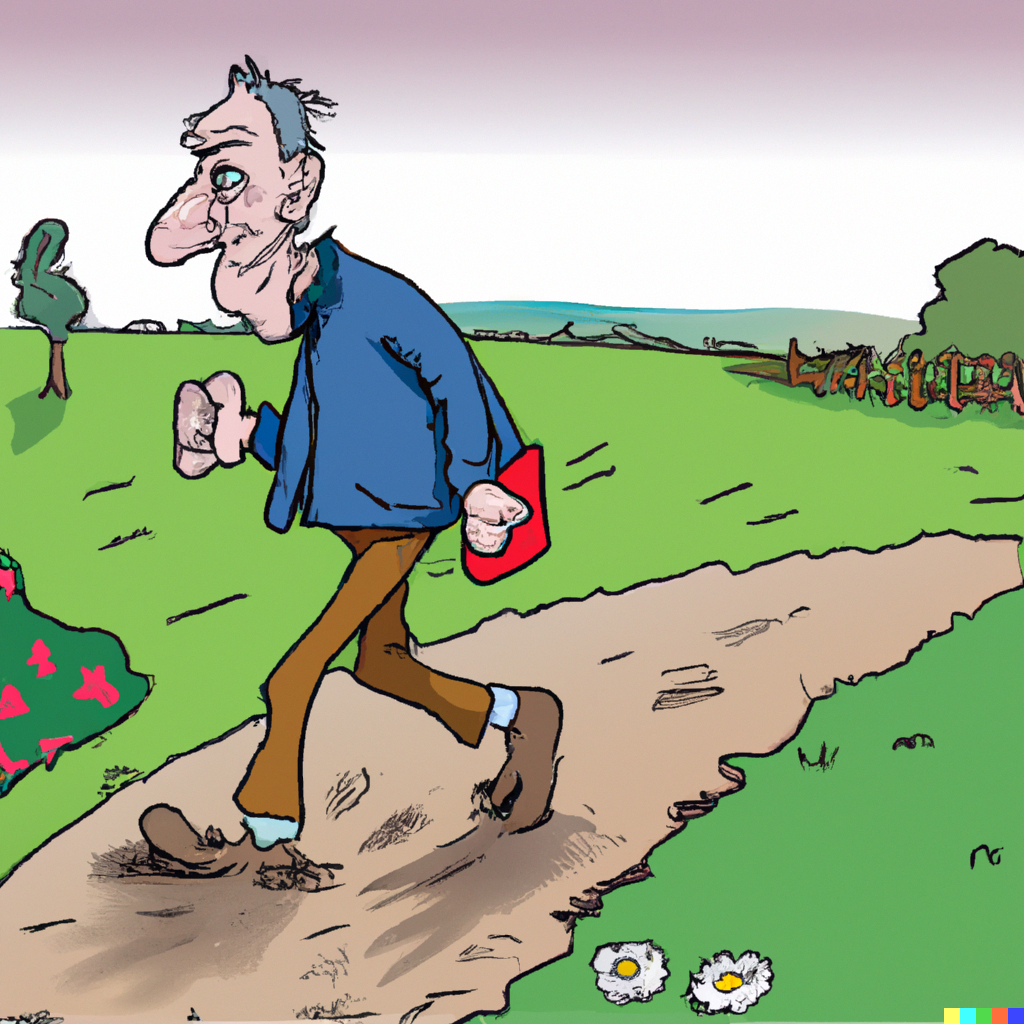
DALL·E 2

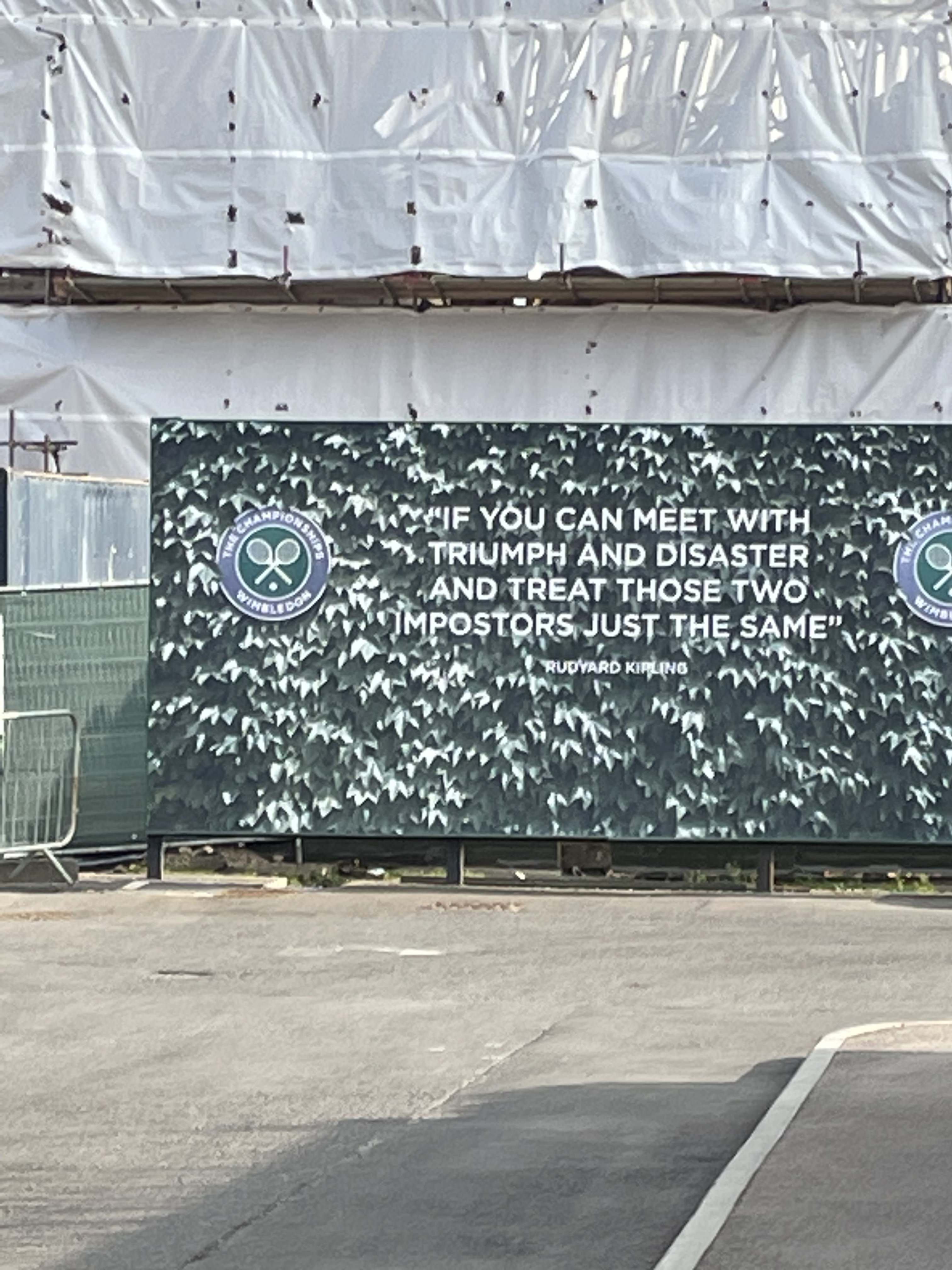
I walked down a road called Grand Drive in Morden today and stopped outside a tennis academy, which had a quote from Rudyard Kipling’s If printed on a large, Wimbledon branded, hoarding:

“If you can meet with triumph and disaster and treat those two imposters just the same.”

Rudyard Kipling

I’ve read If before and like the bit about not losing your head when all around you are losing theirs (and blaming it on you.) Dad quotes that to me occasionally. Working in a Higher Education setting, it’s good advice. But the bit about triumph and disaster hadn’t caught my attention.

It’s interesting that the All England Club Community Sports Ground chose to put this quote in a prominent place (visible from the entrance of the ground). I caught the attention of a security guard in a hut by walking up to the gate so I could take a picture of it.)

“It’s ok!” I reassured the guard, “I’m not coming in, I just want to take a picture of that quote.” He smiled at me in a slightly pitying way and went back to his paper.

But the quote made me think. Often, I hear giddy sports journalists bouncing up to cricketers and trying to get them to display a bit of emotion after a particularly spectacular win, or defeat (mostly win these days, amazingly.) “How did that feel?” they implore, hoping the triumphant captain will drop the veil of grace and humility and admit that they enjoyed smashing all hell out of New Zealand just a little bit.

They absolutely refuse to comply. Presumably, media training these days recommends that an astonishing victory or defeat should not lead to a change in behaviour. Why? Because of the knock on effect on team mates and our own confidence. Melancholy, or complacency, sets in, and performance is negatively affected. Much better then to treat the latest result as a fleeting occurrence, and to get back to the nets.

Tennis stars are much the same. Andy Murray used to come in for a drubbing by the satirical Radio 4 show, Dead Ringers, which used to poke fun at his monotonous responses to any and all questions from journalists. But whatever you think about Andy Murray as a person or a player, the approach is spot on. Whether we win or lose, we should disengage from the result, and get back to practice.

The I Ching agrees. When we look at hexagrams such as 63: After Completion, it counsels to avoid any kind of unbalancing thoughts that might disturb our dignity or independence (Anthony, 1988). The I Ching may be a bit ‘woo’ for many Walk the Pod readers, but my position on things like tarot or tao is that if the guidance is sound, and written by a wise person whose values I agree with, then it doesn’t matter whether cards, tea leaves or the shape of an ink blot was the origin.

I don’t believe that anything supernatural is going on, but I like to believe that in a world where we can occasionally see all of science overturned by a new theory, it’s possible that human intuition taps into something more profound and scientific that we don’t yet understand.

The ancient Persian saying, ‘this too shall pass’ is popular for just the same reason. The good, as well as the bad, shall pass, and this phrase reminds us to take it one day (one hour, or one minute) at a time when things are bad, and to enjoy every moment when things are good. Because nothing lasts for long.

References

Anthony, C.K., (1988) A Guide to the I Ching. 3rd edn. Massachusetts: Anthony Publishing Co.

You’ll never walk alone – trundl review

DALL·E 2

One eyed bloke

I walk, always have. School and back was four miles a day, rain or shine, in clothes made mainly of polyester (oh, the sweaty 70s). Buses were too random, and in any case were full of sharp-elbowed, tough old ladies. So I walked everywhere, and liked it. It was just me and the road and the sky, and we became firm friends.

But I never got into counting steps, I’ve never been tempted to wear a Fitbit and I’m a bit wary of people who do. Hell, I don’t even measure my waistline, except by seeing which pair of jeans fits (the elasticated ones). So, why am I trying out a walking app called trundl?

The short answers are, because trundl is not your typical walking app and my friend Rachel thought I’d like it. And she, I believe, would rather nail jelly to a wall than persuade me into something competitive.

It’s also a sad fact of life in the suburbs – where I and more than half of us live – that, after a few years, our motivation to go out and walk around our all-too-familiar home patch can dwindle, especially if there are no nearby green spaces big enough to get satisfyingly lost in. So, I was kind of in the market for a kick in the backside.

Not that trundl ever kicks; it prefers to nudge. The app sets up a triangular relationship
between charities, businesses (‘brand partners’) and you, the individual trundlr. You pay a
monthly subscription – currently £3.99 – and trundlr commits to giving at least 10 percent of that to the charities. But that’s not the main deal: at the heart of the app are Community
trundls, in which all trundls completed within a period of about a week count towards a
specific distance goal. Reaching the goal triggers extra donations, often given by a business, for a specific charity (they rotate). You don’t have to sign up to a Community trundl; your trundls are automatically counted towards them when one is happening, which is often.

trundl describe their app experience as ‘Go, Give, Get.’ ‘Go’ means recording your walks—trundls—in the app. ‘Give’ means selecting your preferred charities from a list, currently just five. ‘Get’ means getting rewards, which consist of Badges, i.e. markers of your progress, and Offers in the form of discount codes from trundl’s brand partners. There is also News: summaries of past and future Community trundls.

I asked my twentysomething kids if they’d use trundl. They’re digital natives and have a
sharp appreciation of what they see as the true nature of most internet commerce: when
there’s no discernible product or the product is free, you’re the product – or your data is.

So, no surprise when they were sceptical. “What are you getting for your money? You can
count your steps or track your walks for free on any smartphone, and if you want to give
money to a charity, give it direct; they’ll get 100 percent plus Gift Aid instead of just 10
percent. The app is just serving you up on a plate as a niche market to businesses.”

OK, thanks lads. And go easy on the cynicism, it costs, y’know. I don’t doubt the app has a commercial logic behind it. But come on, if the offers work, if they give you discounts on
stuff you actually want, what’s happening is, your subscription is supporting a platform that
promotes a net flow of money through the app from businesses to charities. That’s good,
right? That’s different from direct giving, and maybe better.

I’m a realist, I hope; I know I’m the product and this ideal scenario is likely to be realised for only a fraction of users at any one time, but I’m not just the product; I’m a walker who
believes small acts of kindness help the world to turn – and why let the perfect be the
enemy of the good? Its a great idea to link walking & giving, and I hope trundl succeeds. As the app grows, more users will attract more brand partners and more offers, so the fraction will grow too.

Ideally, I’d like more ways for trundlrs to interact; you can share your trundls on completion
and add a comment, but I feel inclined to share only really big or particularly lovely ones. A
way for Community trundls to connect trundlrs in actual communities would be good.

trundl is aimed at an underserved demographic, one I’m happy to fall slap in the middle of:
those who walk for pleasure as much as health. I believe there’s no niche anyone could cram us all into. We power-walk seldom, amble often; we’re amiable rather than ambitious. And at the end of the day, we want to be tired out by our walking, not our walking app.

Editor’s note: trundl is available from your favourite App Store, check out the app here.

Counting our blessings

DALL·E 2

“Do not dream of possession of what you do not have: rather reflect on the greatest blessings in what you do have, and on their account remind yourself how much they would have been missed if they were not there.

“But at the same time you must be careful not to let your pleasure in them habituate you to dependency, to avoid distress if they are sometimes absent.”

– Marcus Aurelius, Meditations, Book 7, Chapter 27

In this passage, Marcus Aurelius, the renowned Stoic philosopher, Roman emperor, and star of What Would Marcus Do, a much loved segment of Walk the Pod episodes of the past, highlights the importance of acknowledging and appreciating the abundance present in our lives.

It’s all too easy to become fixated on what we lack, and to believe that our happiness and fulfilment depends on obtaining these things. The reality is that once we get to our chosen rainbow uplands, we spot another rainbow upland! Just over the horizon with an extra unicorn!

And immediately, we adjust our happiness downwards to accommodate the JOY we will feel when we reach this new and shiny destination.

But Marcus reminds us that by taking stock of the blessings we already have and cultivating gratitude for them, we can come to appreciate the richness of our lives and find contentment in the present moment.

Perhaps we should scan the horizon only for genuine threat rather than opportunities, and instead pay attention to what’s directly in front of us.

This idea of inner independence is a central tenet in Taoist philosophy, as exemplified in the ancient Chinese text, the I Ching.

I Ching says that true fulfillment comes from within, and encourages detachment from the frustrations of life, alongside the cultivation of inner independence in order to find peace and contentment regardless of external circumstances.

As I explained in today’s episode, I don’t mind if my daily reminders of how to be a happy human in the world are based on a system that taps into the supernatural, IF the advice behind the tarot card, hexagram or tea leaves is sound.

I see these systems, rituals or games more like a trusted friend whose advice I can take or leave. An alternative way of looking at it is as a way to randomise snippets of good advice on subjects that I need reminding of regularly. Such as, for example, not to try to get too much out of a situation, to detach and remember not to strive too much for success.

Simply choose a sound direction, then keep turning up, doing the good work, fighting the good fight and be prepared to seize the moment when those fleeting opportunities come along. And crucially, be prepared to change course when needed, no matter the upheaval required to do so.

Both Stoicism and Taoism advocate for embracing abundance as a means of cultivating inner independence. This is not to say that we should ignore or downplay our struggles, but rather that we should recognise and be grateful for the myriad blessings in our lives, rather than fixating on what we lack.

By following this approach, we can learn to find fulfillment and contentment in the present moment, regardless of external circumstances.

So, how do we go about counting our blessings and cultivating gratitude? Here are a few ideas:

– Take part in GratiTuesday: Take some time once a week to write down a few things you’re grateful for, or voicenote a friend with your GratiTuesday thoughts. These can be as simple as noticing a beautiful sunset, a warm meal, or a good, tipsy laugh with a friend at the end of a long week. Reflecting on these things can help shift the focus to everything that’s provided a little light.

“No matter how vast the darkness, we must supply our own light.”

– Stanley Kubrick

– Practice mindfulness: Pay attention to the present moment and all the good things that are happening. Take a few minutes each day to simply be present and notice the beauty and blessings in your life. Ignore, just for a moment, the cereal strewn around the place or the clothes that have been piling up all week. When the news is bad, look for the helpers, and try to help them.

– Show gratitude: Expressing gratitude to others can not only make them feel good, but it can also help us appreciate the good things in life. Take the time to write a thank-you note, say thank you in person or rugby tackle them to the ground to cover their upturned face with a thousand kisses, if you have consent to do that kind of thing.

– Give back: Helping others can also help us appreciate what we have. Consider volunteering or donating to charity. This series, I’m encouraging everyone to download trundl, the walking app that converts your kms into donations for charities including Dogs for Autism and the Trussell Trust. We hope it will be available outside of the UK before too long.

We have one week to go until the end of Series 33, dear Poddies, and I look forward to completing our topic of abundance.

Of course, I will need regular reminders to flip myself out of scarcity mode, so I dare say we’ll come back to this regularly.

You are warmly invited to join me next Friday evening at 6pm for our end of series wrap party, from 6-7 GMT. Find me in the Discord voice channel, for which you’ll need to join the Walk the Pod lunch time walk club, via patreon.com/rachelwheeley

References

Aurelius, M. (180 AD) Meditations. (Gregory Hays, Trans.) Penguin Classics. (2006)

Phillips, G. D. (2007). Stanley Kubrick: Interviews. University Press of Mississippi.

The illusion of change: how to embrace abundance in the present moment

Hello Poddies,

As I continue to ponder the concept of abundance, something intriguing has come to my attention. And that is, nothing truly changes. We may think that in the future, things will be more manageable, that we’ll have a better grip on our to-do list, or that we’ll no longer be constantly rushing from one thing to the next.

But the reality is, if we’re the type of person who takes on more than is reasonable (guilty as charged), we’ll always find something to fill the void when we don’t feel we have enough to keep us busy.

I’ve certainly experienced this in my own life. I keep thinking that life will eventually slow down, but it never does because I take on more until I reach my limit.

Busyness is similar to the price differentiation marketing strategy of luxury coffee companies?!

They offer the same product at multiple price points to cater to different budgets. So, even if you’re perfectly content with a cheaper option, if you think you can afford the luxury, you’ll end up spending more.

Just like a cheap coffee vs an expensive flat white, there is a level of busyness that suits every person. We may think that having more will lead to greater satisfaction, but it’s important to recognise that it may not be the case. We might do better to appreciate the abundance manifest in what we have instead.

If abundance is the aura that we send out to the universe to say, I’m ready to receive more, then we should be careful what we wish for.

I’m off to have another bath.

Failure is not the opposite of success, just a regular ditch along the path

This weekend, I’ve come to a realisation that has made me see things in a different light.

Recently, I’ve been feeling like I’ve been failing a lot, and as I was reflecting on these failures, I realised that perhaps I shouldn’t feel bad about this. The fact that I’ve been failing a lot is probably because I’m doing new things, pushing myself into areas I haven’t explored before, and trying new creative projects.

It made me think about the concept of flow, which was first introduced by psychologist Mihaly Csikszentmihalyi. According to Csikszentmihalyi, flow is the state in which a person is fully engaged and absorbed in an activity—when our skills are fully matched to the challenge at hand. When we’re in flow, we’re in the right place, and it’s here where we can experience optimal experience, joy and satisfaction.

It’s important to note that flow is not a destination, it’s a journey and it’s not always easy. Being in the flow often means pushing ourselves out of our comfort zones and taking risks. It’s a zone where you will experience occasional anxiety and boredom and the zone where you’ll feel like you’re failing a lot. However the main feeling of flow is of being able to reach our goals, and of learning and growth.

So it’s important to remember that failure is not the opposite of success, it’s a natural and necessary step on the path towards it.

Instead of seeing failure as a negative thing, let’s reframe it as an opportunity to grow and learn. When we’re feeling like we’re failing a lot, it’s a sign that we’re pushing ourselves to the upper limit of the flow zone. It’s a sign that we’re on the right track and that we’re making progress. We should not hurriedly swipe our failure away, but look at it carefully. What happened here? What went wrong? What can we do to ensure the same thing doesn’t bite us in the bum next time?

One of the keys to thriving in the flow zone is to be prepared for failure. Expect it to happen and expect to learn from it.

When we’re prepared for failure, it doesn’t feel so overwhelming when it happens. We can take it in our stride and use it as an opportunity to grow and improve.

Expect others to see our flow path with all its uncertainty, vulnerability and failure, as a demonstration of our inability. Remember that people use this same judgement on themselves to keep themselves safe.

We may safely carry on, knowing that we’re learning, and that whilst we’ll keep failing regularly, we’ll be failing at new and interesting things, while the naysayers perform perfection slap bang in the middle of their comfort zones.

This carrying on, despite all the odds, is called grit or resilience. Resilience means being able to bounce back from failure and keep moving forward. It means being able to pick yourself up and try again, even when things feel tough. A key to resilience is to reconnect often with things which are not the project we’re working on at the moment. Take a step away to regain some perspective. Oh look, I’m failing regularly but the world is still turning, and nobody much seems to care that my latest project fell flat on its face. That’s alright then.

Resilience is an important quality to cultivate when we’re working in the flow zone because we will inevitably face challenges and obstacles.

In conclusion, flow can feel like an obstacle course. It can be challenging and a vulnerable place to be, but it’s also where we experience growth and progress.

So, next time you’re feeling like you’re failing a lot, remember that you’re probably in the flow zone, and practice gratitude for that.

Embrace failure, learn from it, and use it as a stepping stone to success. Above all, remember that you’re the only one who knows what the original plan was.