Tag Archives: philosophy
Going to the crows
Last Tuesday at 2pm, a baby across the street was screaming about the heat. By 7pm I swear it had turned into a crow.
The noise of baby crying its head off and young crow gurgling came from exactly the same direction. And I’ve no evidence to suggest that the baby turned into a crow. But I’ve no evidence for a different explanation, either.
There will be a sub-section of philosophy that deals with this, probably. At the University of York in the early 2000’s, I used to look in awe and wonder at the notebooks of fellow students studying philosophy. I stood in the break room of the University Radio station, gazing in disbelief at a page covered with ciphers, which was probably some kind of logical argument, but I could neither decipher nor understand the subject matter, let alone the detail.
Let A be the proposition ‘A baby exists.’ Let B be the proposition ‘A crow exists.’ Let T be the proposition ‘A baby turns into a crow.’
∀x(Creature(x)→CapableOfSurpriseTransformation(x))
Creature(Baby)
∴CapableOfSurpriseTransformation(Baby)
P(T)=0
I’m making this up, I was a psychology student and we had nothing so useful in our toolkits. We just knew that it was possible to turn your classmates into Nazis by locking them in a basement for 3 weeks. And that hasn’t particularly come in handy in my career, yet.
I tried to engage Child 1 in a bit of whimsical banana-ing about the crow/baby conundrum. Child 1 was not interested because he’s more interested in ‘The Grind’, at the moment. Not Grindr, that’s something else. The Grind is where you go into the forest and kill boar for 37 hours, just to buff your Level 1 avatar to a Level 2, so that you can kill a slightly bigger boar on open ground. I’m being facetious. Child 1 has been at this for years and now has a Level 48 avatar. His eyes don’t work in daylight, but he can one-shot a Zorah Magdaros and that is Something, apparently.
I’m talking about computer games, but I am worried that grinding too much for too long can damage the psyche. The Grind teaches kids that we are weak and feeble and not enough as humans. We have to level ourselves up gradually, we should never expect to stop. Before enlightenment, taught the Buddha, chop wood, carry water. After enlightenment, chop wood carry water.
But keep chopping wood, carrying water, every day, basically. Is it necessary? I know some seriously successful people who are still grinding in their 60s, and I wonder whether there is any point at which they will stop, unless stopping becomes the goal. Presumably, that is the main challenge of retirement. We either spend it genuinely learning to relax, and making friends with the crows, or we spend the entire time chasing more ways to grind, forgetting that the whole point of having been doing this for 40 years is that we can now stop.
Sam is already making friends with the crows by feeding them ham. This has led to a hilarious shopping list which had ‘crow ham’ listed just above ‘ham.’ Because we want to make friends with our local corvids, but we also acknowledge that we can’t be feeding them Tesco Finest Wiltshire Thinly Sliced or we’ll end up bankrupt.
To work actively against Grind culture—even though most of us are still in it for another few decades—Walk the Pod Series 58 will be on the subject of Rest (is Resistance). Your new series starts next Monday 7 July. Listen here.
If you’d like to support my work, you can do so at Patreon: https://patreon.com/c/rachelwheeley, but I’ll always put most stuff out for free. It’s just if you like to keep your local walking podcaster in crow-ham.
Hope: a stirring force for good
Consuming the news, all that is cruel and unfair is laid out for us to read, watch or listen to in all its mawkish detail. Putin remains free to wreak havoc, natural disasters destroy the homes of innocent families, Trump gets another shot at re-election, despite everything. And yet, every time hope gets crushed to the ground, it rises again.
Emily Dickinson’s poem, “Hope” is the thing with feathers calls hope, ‘the thing with feathers, that perches in the soul / And sings the tune without the words / And never stops at all. Hope never stops.

Positive change happens at glacial pace, with as many setbacks as steps forward. Trump and his cronies were referred to as, ‘the last fart of a dying dog’ back in 2016. Whilst not as majestic a phrase as Martin Luther King Junior’s ‘The moral arc of the universe is long, but it bends towards justice’—inspired by Theodore Parker’s sermon on Justice and the Conscience—the ‘dying dog’ brigade and Dr King were on the same page.
They were both trying to say that things get better, s l o w l y. And when things are getting better, sometimes we have to endure a moral Luddite like Trump throwing himself under the wheels of progress, in order to stall things for a few more years.
Diagnosing a problem
We move, at a glacial pace, continually into slightly better circumstances. The Internet, media, and social media help shine a light on what’s happening, so that we can begin to define the curves and edges of our most critical problems. If we can define, we can diagnose.
And as Rebecca Solnit puts it in Hope in the Dark, we do not need to know the prescription before the diagnosis is complete.
In 2016 I quit working in a newsroom and stopped consuming the news for the sake of my mental health. Trump’s election, Brexit, then Covid eventually led to my turning off Radio 4 in the house, so that I could have some peace from the news hurricane.
But having re-read Solnit’s wonderful Hope in the Dark this month, I realise that whilst it’s painful to engage with the details, reading bad news helps us to see the issue properly (media and social media bias notwithstanding), in order to understand what the shape of the problem is—where we are in the fight.
I recently watched She Said, a film of the 2019 book by Megan Twohey and Jodi Kantor about their struggle to expose the systemic abuse of women in Hollywood by Harvey Weinstein, amongst others. Despite pressure to silence the brave women who exposed Weinstein’s horrendous behaviour, these two journalists knew the truth. They were determined to expose it, and have changed the global workplace for women in the process. The subsequent MeToo movement became too overwhelming to document. It has changed the workplace, and the world.
Hope makes the present inhabitable
Hope is, in a sense, a search for the truth. Once uncovered, the truth is there to be held up to the light, if we are brave enough. It is not the likely success of the initiative that should fuel our fight. It is adhering to the truth, and helping to spread it as far as we can.
Solnit argues that we would not have had the same war in Iraq if global publics had acquiesced to the original Bush/Blair plan. The global protest movement surrounding the war changed it. Reduced the scope of it. Made it smaller, and shorter.
The millions of people who marched, the individuals who made ‘STOP THE WAR’ placards didn’t get what they wanted, but they changed the course of things, and who knows how much more extensive the war would have been without them.
To be effective, activists have to make strong, simple, urgent demands…And they have to recognise that their victories may come as subtle, complex, slow changes…and count them anyway. A gift for embracing paradox is not the least of the equipment an activist should have.
rebecca solnit
Solnit points out that hope is not a passive emotion but rather a stirring force that will get people up off their sofas and into the world to make a difference:
Hope is not like a lottery ticket you can sit on the sofa and clutch, feeling lucky… Hope is an ax you break down doors with in an emergency; because hope should shove you out the door
Rebecca Solnit
‘To hope’, Solnit writes, ‘is to give yourself to the future, and that commitment to the future makes the present inhabitable.’
Look for the helpers
The philosopher Ryan Holiday writes in his modern stoicism book, Stillness is the Key, about Fred Rogers, a American childrens’ television presenter whose show, Mr Rogers’ Neighborhood, aired from 1968 to 2001.
“Look for the helpers”, Mr Rogers would tell the children whenever a horrible news story broke in the world. “The world is full of doctors and nurses, police and firemen, volunteers, neighbours and friends who are ready to jump in to help when things go wrong.”
Hope as a way to find purpose
Hope, looking for helpers, and helping itself, gets us through when something utterly unfair is happening. Hope doesn’t mean that everything will turn out ok, but it can help us to find purpose and meaning in a world that seems fundamentally unfair and difficult.
The playwright, intellectual and politician Vaclav Havel used hope as his own lifeline whilst imprisoned between 1979 and 1983. He makes clear that hope is part of the soul, to be found even in seemingly hopeless situations:
Hope, in this deep and powerful sense, is not the same as joy that things are going well, or willingness to invest in enterprises that are obviously headed for early success, but, rather, an ability to work for something because it is good, not just because it stands a chance to succeed.
vaclav havel
Havel went on to be elected President of Czechoslovakia in 1989 after hope got him through his time in prison.
The arc of the moral universe may bend slowly towards justice, but it is up to each of us to help bend it. We must search for, uphold, and spread the truth, however gradual and imperfect the progress.
Though the present remains full of suffering and setbacks, we can make it inhabitable through acts of hope – by looking for helpers, helping others, and finding purpose and meaning. Hope fuels the spirit when circumstances seem bleak; it pushes us to keep fighting for what is right and for the truth.
We may not see the fruits of our labour in our lifetimes, but we can live with purpose knowing we stood for truth and justice. The future is uncertain, yet hope makes today inhabitable and gives us the strength to take the next step.
Triumph and disaster – nothing lasts for long

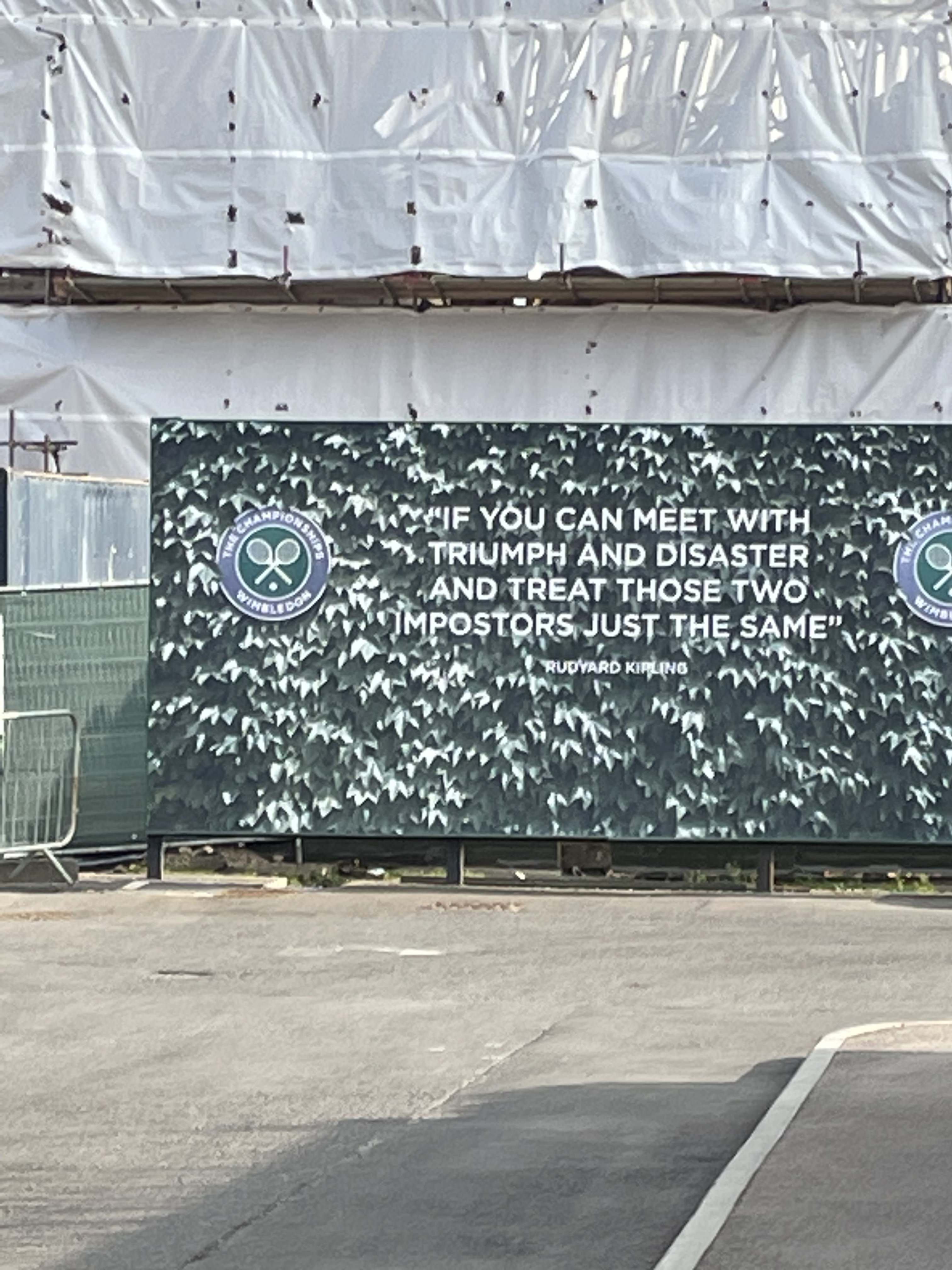
I walked down a road called Grand Drive in Morden today and stopped outside a tennis academy, which had a quote from Rudyard Kipling’s If printed on a large, Wimbledon branded, hoarding:
“If you can meet with triumph and disaster and treat those two imposters just the same.”
Rudyard Kipling
I’ve read If before and like the bit about not losing your head when all around you are losing theirs (and blaming it on you.) Dad quotes that to me occasionally. Working in a Higher Education setting, it’s good advice. But the bit about triumph and disaster hadn’t caught my attention.
It’s interesting that the All England Club Community Sports Ground chose to put this quote in a prominent place (visible from the entrance of the ground). I caught the attention of a security guard in a hut by walking up to the gate so I could take a picture of it.)
“It’s ok!” I reassured the guard, “I’m not coming in, I just want to take a picture of that quote.” He smiled at me in a slightly pitying way and went back to his paper.
But the quote made me think. Often, I hear giddy sports journalists bouncing up to cricketers and trying to get them to display a bit of emotion after a particularly spectacular win, or defeat (mostly win these days, amazingly.) “How did that feel?” they implore, hoping the triumphant captain will drop the veil of grace and humility and admit that they enjoyed smashing all hell out of New Zealand just a little bit.
They absolutely refuse to comply. Presumably, media training these days recommends that an astonishing victory or defeat should not lead to a change in behaviour. Why? Because of the knock on effect on team mates and our own confidence. Melancholy, or complacency, sets in, and performance is negatively affected. Much better then to treat the latest result as a fleeting occurrence, and to get back to the nets.
Tennis stars are much the same. Andy Murray used to come in for a drubbing by the satirical Radio 4 show, Dead Ringers, which used to poke fun at his monotonous responses to any and all questions from journalists. But whatever you think about Andy Murray as a person or a player, the approach is spot on. Whether we win or lose, we should disengage from the result, and get back to practice.
The I Ching agrees. When we look at hexagrams such as 63: After Completion, it counsels to avoid any kind of unbalancing thoughts that might disturb our dignity or independence (Anthony, 1988). The I Ching may be a bit ‘woo’ for many Walk the Pod readers, but my position on things like tarot or tao is that if the guidance is sound, and written by a wise person whose values I agree with, then it doesn’t matter whether cards, tea leaves or the shape of an ink blot was the origin.
I don’t believe that anything supernatural is going on, but I like to believe that in a world where we can occasionally see all of science overturned by a new theory, it’s possible that human intuition taps into something more profound and scientific that we don’t yet understand.
The ancient Persian saying, ‘this too shall pass’ is popular for just the same reason. The good, as well as the bad, shall pass, and this phrase reminds us to take it one day (one hour, or one minute) at a time when things are bad, and to enjoy every moment when things are good. Because nothing lasts for long.
References
Anthony, C.K., (1988) A Guide to the I Ching. 3rd edn. Massachusetts: Anthony Publishing Co.
Failure is not the opposite of success, just a regular ditch along the path
This weekend, I’ve come to a realisation that has made me see things in a different light.
Recently, I’ve been feeling like I’ve been failing a lot, and as I was reflecting on these failures, I realised that perhaps I shouldn’t feel bad about this. The fact that I’ve been failing a lot is probably because I’m doing new things, pushing myself into areas I haven’t explored before, and trying new creative projects.
It made me think about the concept of flow, which was first introduced by psychologist Mihaly Csikszentmihalyi. According to Csikszentmihalyi, flow is the state in which a person is fully engaged and absorbed in an activity—when our skills are fully matched to the challenge at hand. When we’re in flow, we’re in the right place, and it’s here where we can experience optimal experience, joy and satisfaction.
It’s important to note that flow is not a destination, it’s a journey and it’s not always easy. Being in the flow often means pushing ourselves out of our comfort zones and taking risks. It’s a zone where you will experience occasional anxiety and boredom and the zone where you’ll feel like you’re failing a lot. However the main feeling of flow is of being able to reach our goals, and of learning and growth.
So it’s important to remember that failure is not the opposite of success, it’s a natural and necessary step on the path towards it.
Instead of seeing failure as a negative thing, let’s reframe it as an opportunity to grow and learn. When we’re feeling like we’re failing a lot, it’s a sign that we’re pushing ourselves to the upper limit of the flow zone. It’s a sign that we’re on the right track and that we’re making progress. We should not hurriedly swipe our failure away, but look at it carefully. What happened here? What went wrong? What can we do to ensure the same thing doesn’t bite us in the bum next time?
One of the keys to thriving in the flow zone is to be prepared for failure. Expect it to happen and expect to learn from it.
When we’re prepared for failure, it doesn’t feel so overwhelming when it happens. We can take it in our stride and use it as an opportunity to grow and improve.
Expect others to see our flow path with all its uncertainty, vulnerability and failure, as a demonstration of our inability. Remember that people use this same judgement on themselves to keep themselves safe.
We may safely carry on, knowing that we’re learning, and that whilst we’ll keep failing regularly, we’ll be failing at new and interesting things, while the naysayers perform perfection slap bang in the middle of their comfort zones.
This carrying on, despite all the odds, is called grit or resilience. Resilience means being able to bounce back from failure and keep moving forward. It means being able to pick yourself up and try again, even when things feel tough. A key to resilience is to reconnect often with things which are not the project we’re working on at the moment. Take a step away to regain some perspective. Oh look, I’m failing regularly but the world is still turning, and nobody much seems to care that my latest project fell flat on its face. That’s alright then.
Resilience is an important quality to cultivate when we’re working in the flow zone because we will inevitably face challenges and obstacles.
In conclusion, flow can feel like an obstacle course. It can be challenging and a vulnerable place to be, but it’s also where we experience growth and progress.
So, next time you’re feeling like you’re failing a lot, remember that you’re probably in the flow zone, and practice gratitude for that.
Embrace failure, learn from it, and use it as a stepping stone to success. Above all, remember that you’re the only one who knows what the original plan was.
Abundance
Series 33 of Walk the Pod will explore the topic of abundance.
An abundance mentality is the belief that there is enough for everyone and that there are unlimited resources and opportunities available. It is the opposite of a scarcity mentality, which is the belief that resources and opportunities are limited and must be fiercely guarded or competed for.
The ancient Greek philosopher, Zeno of Citium, who founded the school of philosophy known as Stoicism, believed that true abundance and prosperity come from within and cannot be gained through external means. He believed that living a simple, uncluttered life and focusing on one’s own personal development and virtue was the key to true happiness and contentment.
I my own life, I often fall into a scarcity mindset. I do not have enough money, time, biscuits… I have to flip myself into abundance. It needs doing repeatedly, and is difficult to achieve. I thought I’d kick off my thinking for the new series with a few ways to access abundance.
“Contentment is natural wealth, luxury is artificial poverty”
Socrates
Practice gratitude
Take time each day to reflect on the things you are grateful for. This can help shift your focus from what you lack to what you have. Share with friends or family on #Gratituesday.
I practiced this Gratituesday practice during lockdown with my sisters, and it helped. When you know you will be listing things you are grateful for every Tuesday, it does help you to notice them every day!
Focus on abundance, not scarcity
Pay attention to your thoughts and try to catch yourself when you start thinking in terms of scarcity. Instead, try to reframe your thoughts in terms of abundance.
Notice things which make you feel a sense of abundance in day to day life. A computer game with a vast array of quests to complete, a perfectly written first page to a thick book, a full fridge, a big ball of wool (!) all of these things can contribute to a sense of abundance.
Surround yourself with abundance-minded people
The people you spend time with can have a big influence on your mindset. Surround yourself with people who have an abundance mentality and who encourage and support your goals and dreams.
Practice generosity
Helping others and being generous with your time, resources, and support can help me to feel abundant. If I have enough to give something away, then I must have a great deal.
Wealth consists not in having great possessions, but in having few wants.
Epictetus
What does abundance mean to you? I’d love to kick off the new topic in the comments with you, so do add your thoughts to this post.
I look forward to starting the new series next Monday 9 January. And if you haven’t listened to Walk the Pod before, do give it a listen.
Walk the Pod Series 24 Episode 2 – Transcript
WtP S24E2 | Do not fuss
Introduction
Hello and welcome to Walk the Pod, your daily walking show where I take my podcast for a walk because I don’t have a dog. You take 10 minutes out of the day, to walk in nature and pay attention to what’s directly in front of you. My name is Rachel Wheeley, a podcaster and human in the world trying to figure out how to be. I’m on the cycle path in SW19, Wimbledon, as a cyclist zooms past on the bike track to my left.
Kids are whooping and hollering in the Wimbledon Chase Primary School to my right. And the trees are resplendent above me with their little buds. No leaves, but those little buds promises what’s to come. absolutely delighted to be here walking with you again this lunchtime as a very tall person comes towards me with a tiny baby attached to their chest by means of a sling and somebody behind them pushing a pram.
I’ve got Stoics on the Cycle Path for you today, Poddies. Not Seneca today, but Marcus Aurelius, another wise person who knew how to survive 2022 2000 years ago and will be paying attention to what’s directly in front of us of course, as we always do.
Welcome to Walk the Pod.
Paying attention to what’s directly in front of me
My lovely friend Ariana sent me a message just now saying it’s mild out and it is mild out. So actually, it’s really quite pleasant out here today and can’t see the sun. It’s kind of grey and mis. Or at least it looks grey from inside but it’s actually actually warm. And I can see a tiny speck of blue sky. A little pinhole in the clouds shows me that the blue sky is still up there. And there’s some kids kicking a football around on the field. The Thameslink train is going over the railway bridge in the distance very much business as usual on the cycle path this afternoon.
There are 1000 million scooters parked up just inside the chain link fence in the primary school and walking past a prescription on the floor sure we’ll see what it’s for. I don’t know whether Can you read other people’s prescriptions? I think if they’ve dropped them on the floor you can cite slight dizziness other thing I don’t know.
Stoics on the Cycle Path
We were talking yesterday about friendship. Seneca was advising his friend to be very slow, to make a friend to spend a good while passing judgement on somebody before accepting them as a friend. But then to embrace them wholeheartedly.
And today’s Stoics on the Cycle Path is from Marcus Aurelius. Now another very, very wise person who I’ve often gone to for advice. Marcus Aurelius wrote a book called Meditations, which essentially was him just jotting down things to himself. sayings that he’d heard from other places. Wise mottos he had picked up from around the place and at the beginning of Meditations, he lists all his mentors and people who’ve given him wise advice over the years.
And he just kept writing these things down until you had books and books and books of them. This one is from book six. And it is the 27th entry in book six. He says,
“How cruel it is not to allow people to strive for what seems to them, their interest and advantage. And yet in a way, you are forbidding them to do this. When you fast that they are wrong. They are surely drawn to their own interest in advantage. But it is not actually so well then teach them show them do not fuss.”
And this is a big theme of Marcus’s Meditations, the idea that he should just be a good person. Don’t wang on to other people about how good you are. Or try to try to sort of humble brag your way through life, explaining to people how wise you are just just demonstrate it by being a good person.
And here, I think he’s saying, let other people pursue whatever seems right to them, even if it makes absolutely no sense whatsoever to you. And that is pretty good advice, I think because we can expend an enormous amount of energy wondering why other people do and say all the things other people do and say. It’s, ultimately, wasted energy that we’re never gonna get back. best just to think well, different people like different things. Get on with our own lives.
If you have a favourite piece of Stoic philosophy, do share it with me because I’m very happy to share other people’s favourite bits of Stoic philosophy. And let’s see whether we can glean any wisdom together out of it.
You can email: rach@rachelwheeley.com. You can go to walkthepod.com and press the button marked ‘message.’ And you can leave me 59 seconds of your beautiful voice. You can go to my Instagram @walkthepod you can press the button marked contact. And I was really hoping that will take you to my whatsapp, but apparently it isn’t quite that straightforward.
But see if you can see if you can navigate that. Nigel of Galicia very kindly had a go at that for me yesterday, it doesn’t entirely work. I’m gonna keep working on it, but he’s gonna keep working on it
Daily walking is good for you
it’s nice having a walk. I don’t know whether you’re in the habit of having a daily walk away from your desk at lunchtime. But I highly recommend it. If you’re listening to this podcast while you’re indoors, that is allowed. I’m not going to ban you from listening. But I would much prefer you to use the podcast as an excuse to get out the door at lunchtime have a walk.
Only listen to the podcast while you’re walking and just see what happens. I think you might be surprised by the mental health and physical health benefits of daily walking around your local area particularly if you have some nature around you. And particularly if you have a dog.
I don’t have a dog but I might just take my podcast for walks as if it’s a dog. That’s a normal thing to do. I can see loads of pups in the distance over there. My favourite type of dog little brown dogs are not good at identifying dogs, little brown dogs saying hello to each other.
New kittens on the block
Also, very excitingly, have some kittens, new kittens on my block where I live. So I was watching them this morning. One of them which is white with grey splodges likes to sit under the hedge and watch people walking around. And so it goes and sits in its usual spot every morning and has a good has a good look at everybody whilst keeping nice and safe under the hedge so that was entertaining.
And then of course we also have many squirrels that live where I live so I always have fun watching them as well. I managed to get a picture of one this morning, but it will my lens clips going if you know lens, it’s like Instagram stories, but it’s for Patreon. So, the pod walking club got pictures of the squirrel.
Every squirrel is called Peanut by the way, I don’t know whether you know that. But I’m got the pictures of peanuts this morning. So it’s quite proud to have captured it. One of them is have a picture of a squirrel the other one is a half a squirrel as it leapt out of the out of the shot as I was trying to take a second picture of it just walking under the railway bridge now as you can probably hear sound changes ever so slightly.
It’s kind of windy today. So if you’re getting a lot of wind noise I apologise why I’m trying to trying to baffle it with my very high tech solution of the cuff of a gardening glove which I’ve cut off the bottom of the said garden glove and have looped over the bottom of my phone in order to create a bit of a baffle from wind noise. This is what this is what 10 years of BBC sound engineering teaches you how to baffle with noise from your podcast. That was not time wasted, was it?
Outro
Anyway, listen, I think it’s time I went now I’ve got to go and do a few errands. But um, because I’m not working this week, I’m resting this week. Getting better from the surgery I had a couple of weeks ago. And so I’ve got a few errands to do not actually working afternoon. But thank you for walking with me as ever.
And I am going to be back tomorrow with another daily episode of Walk the Pod. So remember, if you want to take me up on my challenge, to listen to the next episode, on a lunchtime walk, and then you can always report back to me how it went. And one of the ways that I mentioned earlier you can also tweet me @rachelwheeley if you like that sort of thing. So take care of your beautiful mind this afternoon. And I look forward to speaking to you again tomorrow.
 Rachel Wheeley MCIPR FRSA