Unknown's avatar

About Rachel Wheeley

Host of daily walking podcast Walk the Pod

How to Remember a Speech – Think Like a Drummer

I’ve written before about memory walks. But the problem is they can disconnect you slightly from the audience.

In your head you’re in a different place and I’m not sure on their own they’re enough.

Then I listened to an excellent podcast episode by Tim Ferriss. Tim was talking to one of the greatest drummers on the planet, Dave Elitch. If you haven’t heard of Dave, this video of him on tour with the Mars Volta is worth checking out if you don’t have a gig nearby!

Dave is one of those drummers that artists like Miley Cyrus call when their drummer suddenly breaks their arm or similar. Dave goes in for a rehearsal with a band, picks up their entire back catalogue in three weeks, and then goes on tour with them. Bearing in mind the drummer can make or break a gig all together, we need to learn from this man.

How does he do it?

I’ll play the song; I don’t know, like five or 10 times with my notes. And then I start, “Okay, I think I got it now.” Then I’ll put my notes away and just play. No, sorry. Then I’ll play with just the notes, no music. Then I’ll play –

Tim Ferriss: As you were saying. So you’re accompanying the music first with your notes.

Dave Elitch: Yes. And then when I get comfortable the next step –

Tim Ferriss: Turn off the music.

Dave Elitch: – and just play with the notes. And then the next step is music, no notes. And then the final step is just a click track, nothing else. So just a click track.

Tim Ferriss: Click track metronome.

Dave Elitch: Yeah. So I hear nothing, and I have to know it so well that I can get through the whole song in my head, hearing everything. That’s an insane amount of work. But the deal is when you get on stage, and there are 30,000 people screaming, and like with Miley (Cyrus), people throwing bras and underwear at me.

Tim Ferriss: Better than batteries and tomatoes, I guess. Or beer bottles.

Dave Elitch: Like at that moment, you have to know everything so well that that’s not going to faze you. It takes a long time. I’m in there for 10 or 12 hours at the beginning.

We’ve all been at one of those gigs where people are throwing batteries at us, right? No, me neither.

And then Ferriss goes explains how he goes about trying to learn a keynote:

Tim Ferriss: I want to note something for folks, and I’m so glad we got into this because that particular way that you laid out your progression for practicing a song is nearly identical to how a lot of the best public speakers also prepare their keynotes. They will take a keynote – and I learned to do this as well, but I was borrowing from other people – and instead of – let’s just say for the sake of simplicity, a 60-minute keynote – rather than trying to give the 60-minute keynote from start to finish, they’ll break it into four pieces.

Or what they’ll do – and this is something I started to model – is because the beginning and the ending is so important, actually breaking out the first five minutes and the last five minutes. Let’s make it simple. If it’s a 40-minute talk – this will make the math a little easier – first five minutes, then you have three 10-minute sections and then the last five minutes. And to practice each one of those individually, as opposed to in sequence. Initially, not paying attention to time, although having some rough idea of the total length. And then recording, listening to it, making these post-game analysis edits necessary.

So I’m going to try this. I have a 30 minute set to do on Wednesday night (come along if you’re around!) I’ve written 25 minutes worth of jokes, so I’m going to try to learn the first five, the last five, and then two chunks of about 7 in the middle.

The whole interview with Dave Elitch is here.

Do you have to learn stuff by heart? How do you go about it?

Amélie: BFI Comedy Genius Tour

poster

On Wednesday 12th December I’ll be presenting Jean-Pierre Jeunet’s fabulous Amélie, the classic comic fantasy that launched Audrey Tautou to stardom.

Tautou stars as the lonely waitress who finds ways to bring others the happiness (or comeuppance) they deserve, and eventually finds her own happy ending. It’s an imaginative, sassy romp through a Parisian dreamworld, filmed and acted with joyous flair.

This screening is part of Comedy Genius, a nationwide celebration of comedy on screen led by BFI, the Independent Cinema Office and BFI Film Audience network, supported by funds from the National Lottery. For more screenings go to bficomedy.co.uk. #bficomedy

Booking: http://www.davidleancinema.org.uk/event/amelie/

The Unfortunate Bisexual

TheUnfortunateBisexual

Tonight Cerys Bradley and I are taking a brand new work in progress show to the Harrison in Kings Cross.

We’ll be trying out new ideas in what is hopefully going to be a barnstorming Edinburgh show once we’ve tried it out a few times and knocked all the edges off the thing.

What does it mean to be bisexual? No, actually, what does it mean? Are we doing it right? How can you tell?

Join comedians Rachel Wheeley and Cerys Bradley for a night of comedy as confusing as coming out and as ridiculous as trying to explain the in’s and out’s of attraction to everyone you meet. They will each tell you their remarkably different experiences of being bisexual in this work in progress show that definitely wasn’t conceived in a desperate bid to validate either of their sexualities. There will be jokes, there will be tangents, there will be graphs, and more, because why have one thing when you can have many?

If you wanted tickets to this but missed out, check out our second work in progress show at Angel comedy in January.

‘The Evolution of Truth’ at the Royal Institution

rishot.jpg

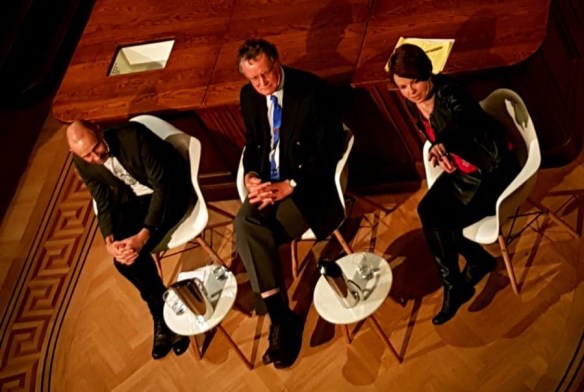
I chaired a couple of talks at the Royal Institution at the beginning of the month, with Evan Davis and Richard Byrne.

Here is a somewhat upside-down action shot taken from the balcony, of the three of us during the Q&A at the end of the session.

Both talks were a fascinating insight into deception. First of all Richard Byrne spoke about primates and whether they have any understanding of the deception they sometimes practice, and then Evan spoke about bullshit, what it is, and why it’s suddenly an important force in global politics.

There was a lively Q&A afterwards with lots of people interested to know what we can do about the post-truth reality we now seem to live in.

History Showoff at Fulham Palace

History_Showoff_Oct2018_2.jpg

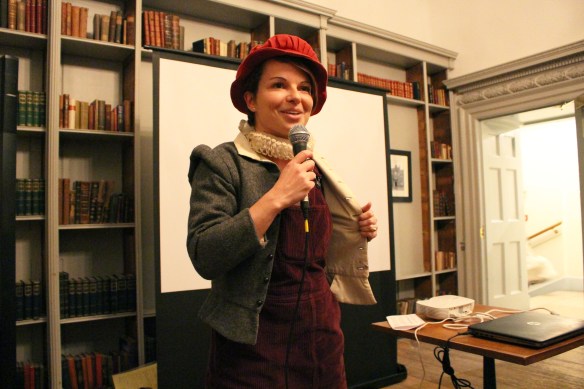
I hosted a couple of History Showoff gigs at Fulham Palace last week. This was a really lovely event in an historic palace which reminded me of the architecture of Eton, where I grew up.

We had a couple of speakers per show, talking about Tudor superstitions, a Victorian forgery of a Tudor merchant’s diary and an Anne Boleyn tattoo, amongst other things. And then we retired to the bar to get hammered on mead. It was fab.

Thanks to Peter Hose for the photo and Steve Cross for the gig.

Edinburgh show: Meet in the Middle

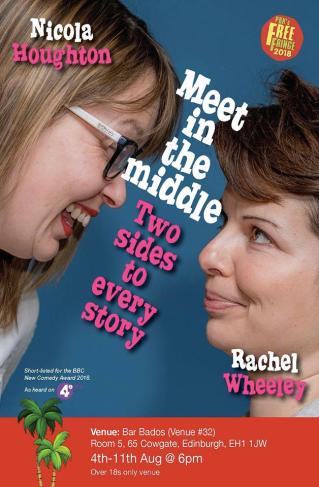
Show posterIn three days time, Nicola Houghton and I will be heading up to the Edinburgh festival to perform our brand new show, Nicola Houghton & Rachel Wheeley: Meet in the Middle.

The Edinburgh fringe is the single biggest celebration of arts and culture on the planet. Last year there were over 50,000 performances of 3,398 shows in 300 venues all over the city and this year there will be even more.

This year, one of those 3,000 shows will be ours!

Nicola and I are neighbours with three kids each, but we’re from very different backgrounds. Nicola grew up in a working-class household on the gravy-soaked cobbles of The North, surviving thanks to raffle prizes, knitted underwear and treasures found in skips. Meanwhile I was growing up at Eton College, entirely failing to get off with Prince William and mixing with teenagers who had never seen an onion. I didn’t go to school there, because they don’t accept women. This is the story of how that panned out.

If you’re going to be in Edinburgh between the 4th and the 11th, drop into Bar Bados on Cowgate at 6pm to see what we’ve been working on! We’re hugely indebted to Steve Cross and Andrew Smith for photography and poster design respectively. Thanks to everyone who came to see our London previews. I’ll let you know how it went when I get back!

BBC New Comedy Award 2018

Aside

p05bclmh

I was lucky enough to be shortlisted for the BBC New Comedy Award this year. My heat was at Up the Creek in Greenwich, hosted by Dane Baptiste and judged by BBC comedy producer Victoria Lloyd, Steve Bennett from Chortle and Holly Walsh.

I was excited to be in a heat with Benji Waterstones and Thanyia Moore, and met half a dozen other fantastic acts, many of whom I’ll be booking at Comedy at the Wheatsheaf before too long.

It was a really fun evening. The radio show of the heat can be found here!

Stand Up for Towel Day – we’re Belgium well doing it again!

Douglas&suitMarch 8th marks the 40th anniversary of the very first broadcast of a radio series called The Hitchhiker’s Guide to the Galaxy.

Douglas Adams was inspired to write a guide to the galaxy while lying drunk in a field near Innsbruck with a copy of The Hitch-hiker’s Guide to Europe and looking up at the stars. Obviously it didn’t start exactly there. It must have come back to him later.

It is an absolutely extraordinary series, brought to life by the series producer, Geoffrey Perkins, with a little help from the BBC Radiophonic Workshop.

When Adams died in 2001, Hitchhiker fans across the world celebrated his life by carrying a towel with them for the day, after one of the show’s central tenets, “always know where your towel is.”

Since then, #towelday has been an annual celebration. In 2016, I looked around for a comedy gig to do on that night with a H2G2 theme, only to find that there wasn’t one. So in 2017, I organised one, complete with poetry, towels, copious amounts of #tea or alternatively, Pan Galactic Gargle Blasters, if you’re that way inclined.

That night was a whole bunch of fun, so we’re doing it again. Do come and join us if you’d like to.

The gig is in aid of Save the Rhino International.

Adams became interested in conservation in 1985 after the Observer Magazine sent him to investigate Madagascar’s endangered Aye-aye, accompanied by zoologist Mark Carwardine.

This resulted in a radio series for the BBC and a book, both entitled Last Chance to See, in which he and Mark visited rare species including the northern white rhinos of Garamba National Park in the Democratic Republic of Congo.

Douglas Adams became a founder patron of Save the Rhino in 1994 and was a dedicated spokesperson for SRI right up until his death in 2001 at the age of 49.

At his virtual 60th birthday party there were 8 tap dancing rhinos on stage at the Hammersmith Apollo: https://www.youtube.com/watch?v=lsLYBF09VFA

Save the Rhino International’s top priority is to protect and increase rhino numbers and population distribution in Africa and Asia. The charity currently supports field programmes in Kenya, Tanzania, Zambia, Zimbabwe, Namibia, South Africa and Indonesia.

Stand Up for Towel Day is proud to donate all our proceeds to SRI. There will be donation boxes at the gig if you would like to make an additional donation (think of it as buying your favourite rhino a gargle blaster.)

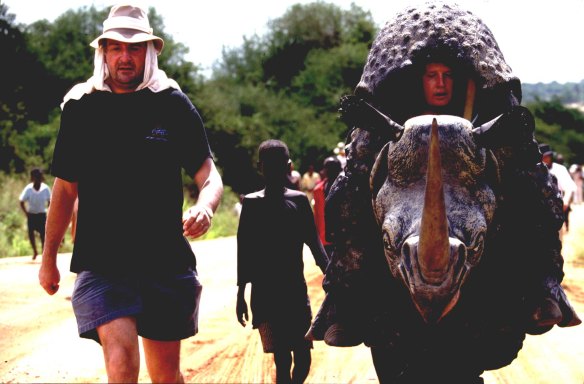
The photo is of Douglas climbing Mt Kilimanjaro in a rhino suit in aid of the charity.

See you on #towelday!

How to Remember a Speech

I have stood on a stage and told jokes for a little over three years now, and I think my memory has got worse. To start with I would practice my 5 minute set half a dozen times during the day, and emblazoned my set into my brain, to the point where I could see the words on the page as I said them. Whether or not this is conducive to a successful comedy performance is another question.

As time went by I found myself with less time to rehearse, plus this technique is not fool proof. There have been times when despite rehearsals I have managed to miss things, or got sections in the wrong order.

More recently I have written my set list on my hand and spend half the set gazing at the resulting black smudge, which is about as good a look as losing your place entirely.

So I decided I need a better technique. I experimented with a ‘bead and thread’ method, where the string is the thread that runs through your talk and the beads are the key moments you want to remember.

However the problem with this was that it was very difficult to remember what order the beads were in. Then I remembered something about ‘memory palaces.’

What on earth is a memory palace and how will this help me?

I prefer to think of it as a memory walk. I don’t know about you but the only palaces I’ve ever visited weren’t particularly memorable, as I only visited once. However I have vivid memories of places I visited regularly as a child. One of these will do nicely.

How to create a memory walk

This takes focus and a little bit of quiet concentration. If you’re into meditation, I would recommend doing some before you start, to quiet your head down. Memory is a brain-wide process, so the quieter your whole brain can be at the beginning, the better this is likely to go.

Write a simple shopping list, or dig out an existing set list to practice with.

  1. Remember a journey that you have taken a lot. Ideally this will have lots of interesting sights or bits of street furniture on it that you can turn into ‘stations.’ Walk the journey through in your mind a few times, noting any interesting places along the way.
  2. Break the walk down into ‘stations’, in the order that you first envisioned the walk.
  3. Move through the stations, placing an item on your set/shopping list at each one. Make the imagery as vivid as possible. If the item can interact with a place on the walk in a surprising way, so much the better.

If helpful, combine the image with a number so that you will easily be able to recall which item on your list you have got to with each station. You could place two mental images of the item at station number two, for example. Later on, six people holding item number six. Or somebody in a number 7 football shirt holding item number 7. The more imaginative you can be with this, the better.

It may also be useful to create a ‘9 station’ memory walk and a ’12 station’ memory walk, for example, so that you have completely different journeys for different set lengths/shopping lists.

Are there any other techniques that are helpful?